AI Automation Audit for Small Teams: A Practical Guide
How to run an AI automation audit for small teams: a realistic workflow example, what breaks, what to build first, and how Animas AI turns audits into shippable systems.
Quick answer
An AI automation audit for a small team reviews day-to-day operations to find high-volume, repeatable tasks where AI can safely take over. It maps triggers, data sources, decision points, and handoffs for workflows that are well documented, have few exceptions, and produce clear outcomes. The result is a prioritized list of buildable automations, not a theoretical report. Done right, the audit leads straight to a working prototype.
A realistic workflow example
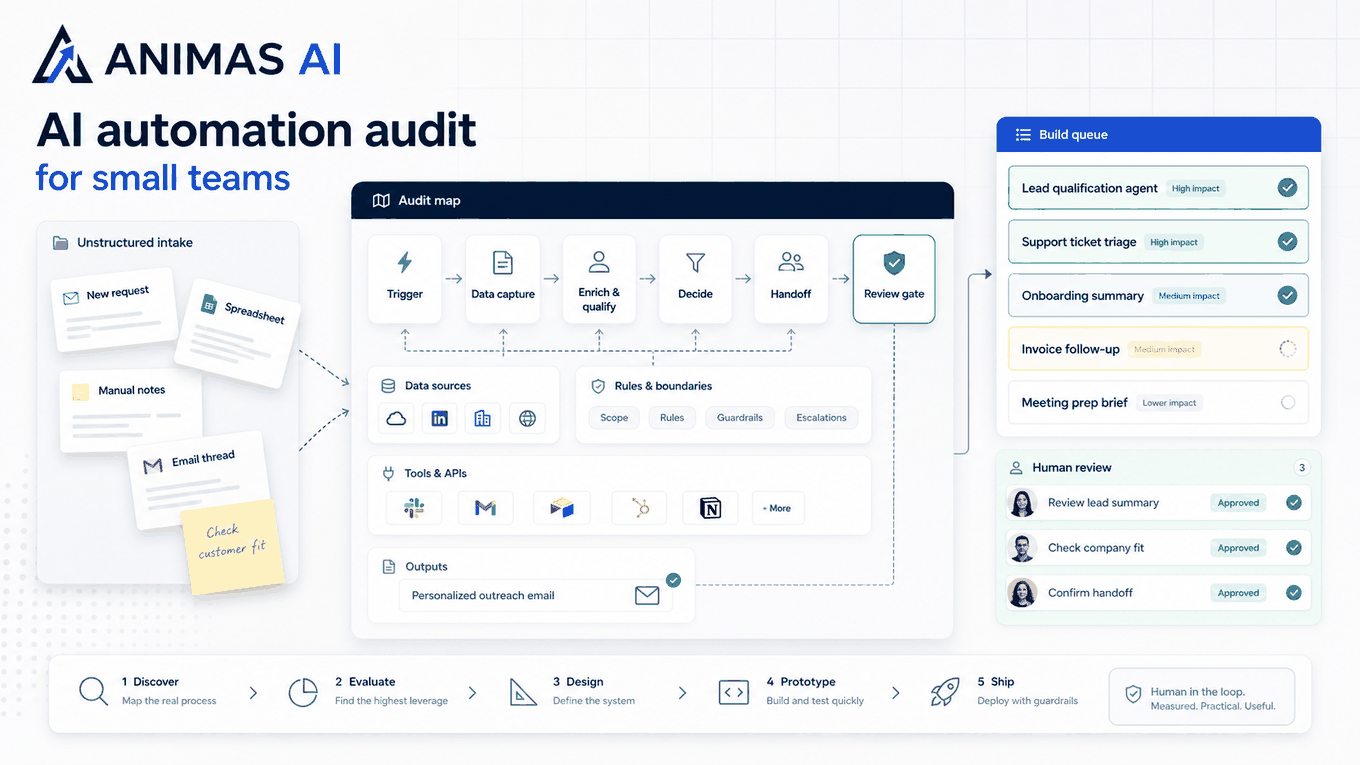
A five-person marketing team audits their lead-qualification process. A new "Request a Demo" form submission triggers the marketing manager to check the CRM, copy data into a spreadsheet, draft a personalized email, and update the pipeline. That takes roughly 25 minutes per lead, with 8 to 15 form fills daily. She hands the lead to sales after the email, without a second review of her own work. If she misjudges a company's size, the sales team wastes time on a bad fit.
During the audit, the team maps the happy path and the top three exceptions: duplicate submissions, missing company name, spam. They notice that steps 1 to 3 are rule-based and text-heavy, exactly where a language model adds value. An AI agent could enrich the lead from public data, score it against their ideal customer profile, and draft the email. The manager moves from doer to reviewer: she skims the draft, adjusts if needed, and approves. The email goes out in under 2 minutes instead of 25. If the model hallucinates a company size, the manager catches it during review. The failure path is visible.
This is the kind of opportunity an audit surfaces: a single, well-scoped loop with a built-in safety net. When Animas AI built a speed-to-lead sprint for a similar pattern, the core automation was live in a week.
What breaks in real teams
- Auditing without the process owner. The person doing the work knows the messy exceptions. Skip them and you miss the real 12-minute daily fixes.
- Over-optimizing the happy path. Real work includes unexpected PDFs or calls. Spend at least a third of the audit on edge cases.
- Targeting judgment-heavy tasks. Automation degrades empathy, creative taste, or fragile relationships. Label human-required steps clearly.
- Ignoring integration points. If the tool can't read or write to daily systems without manual exports, the automation becomes a data-entry burden. Map the real tools; a process diagram alone isn't enough.
- No review state. An automation without human oversight is a liability. A single bad output erodes trust, and teams abandon the tool.
- Mistaking volume for readiness. High repetition doesn't guarantee AI readiness. Dirty or inconsistent data leads to low-quality output and more correction time.
These patterns appear in back-office and content pipelines. The fix: tighten the scope, keep a human in the loop, and automate one decision at a time.
What to build first
Score each opportunity on volume, exception rate, error cost, and integration depth. The best first project is almost always a "copilot" style automation, where the AI drafts and a human approves. Examples: meeting summaries, invoice extraction, email routing.
Start with a one-week build that shows value. For instance, Pip tackled transaction matching across three disconnected systems, cutting manual minutes while keeping every match in a review queue. Masthead turned briefs into ready-to-edit first drafts. A quick prototype derisks the investment: if the team uses it for a week and the time savings are real, expand it. If not, you learned something without a six-month commitment.
What to avoid
- Automating a broken process. Fix the manual flow before adding AI. Technology won't repair a bad design.
- Big-bang transformations. Small teams need a single boring task removed, not a year-long overhaul.
- Overestimating AI's ambiguity handling. If a human pauses to decide, the AI will likely struggle too.
- Ignoring daily tools. If the automation lives in a separate tab, adoption will be low. Embed it where people actually work.
- Skipping failure planning. Define monitoring, alert, and rollback before writing any code.
- Treating the audit as a one-time event. Quarterly check-ins catch new automation opportunities and stale automations to retire.
The audit is useless if it stays in a slide deck. Animas AI's solutions always end in a working tool, not a recommendation document.
How Animas thinks about it
Animas AI uses the audit as the start of a build, not a consulting exercise. It's the discovery needed to deliver something the team will actually use.
Our process:
- Shadow the work. Observe real steps, including the five-minute workarounds no documentation mentions.
- Map the decision points. Where a human pauses, that's either an AI boundary or a place for a review gate.
- Identify the data graph. Pinpoint where input data lives and where output must land. If those connections aren't stable, the automation will rot.
- Prototype within days. For the highest-value opportunity, we build a thin AI pipeline, often using patterns from Pip or Masthead.
- Iterate with the team. The first version always misses something. Real use reveals edge cases, and we adjust before hardening.
Shipping a working tool quickly means the audit pays for itself. The team recovers time through the first automation, and the process becomes an ongoing rhythm instead of a one-time report.
FAQ
How is an AI automation audit different from a regular process audit?
A regular process audit optimizes existing manual steps. An AI automation audit specifically identifies where language models or pattern matching can replace or augment human work, and it evaluates the unique risks of AI outputs.
How long does an audit take for a team of five to ten people?
A focused audit on 3 to 5 core processes takes one to two weeks for a small team.
Do we need a technical team to run the audit?
You need someone who understands how your existing tools connect. Process knowledge matters more than coding ability. External builders like Animas AI can lead the technical side.
What if our processes aren't documented at all?
Undocumented processes are ideal, because the audit becomes the documentation. Watching the work often reveals consistent manual patterns.
Can AI automate tasks that involve talking to customers?
Routine, low-emotion tasks like booking questions can be automated, but complaints, negotiations, or emotional nuance should stay with a human. The audit draws those lines explicitly.
Source notes
- The audit-to-build rhythm described here mirrors the 7-day speed-to-lead sprint Animas AI has used to fix lead-response gaps for small teams.
- The transaction-matching example draws from patterns used in Pip's back-office automation pipeline.
- Content creation and editorial review workflows reference the Masthead case study, where AI drafts go through a human-in-the-loop review.
- General principles like keeping scope small, building a prototype fast, and always including a review state come from Animas AI's practice of building practical AI systems for messy operations, as described in What I build.

Want this kind of system in your business?
Send the messy workflow. I will help turn it into a practical AI system.
Email Tyler