AI Automation Consulting for Messy Operations: A Practical Guide
How AI automation consulting works when operations are messy: real workflow examples, what breaks, what to build first, and how Animas AI ships systems that handle the chaos.
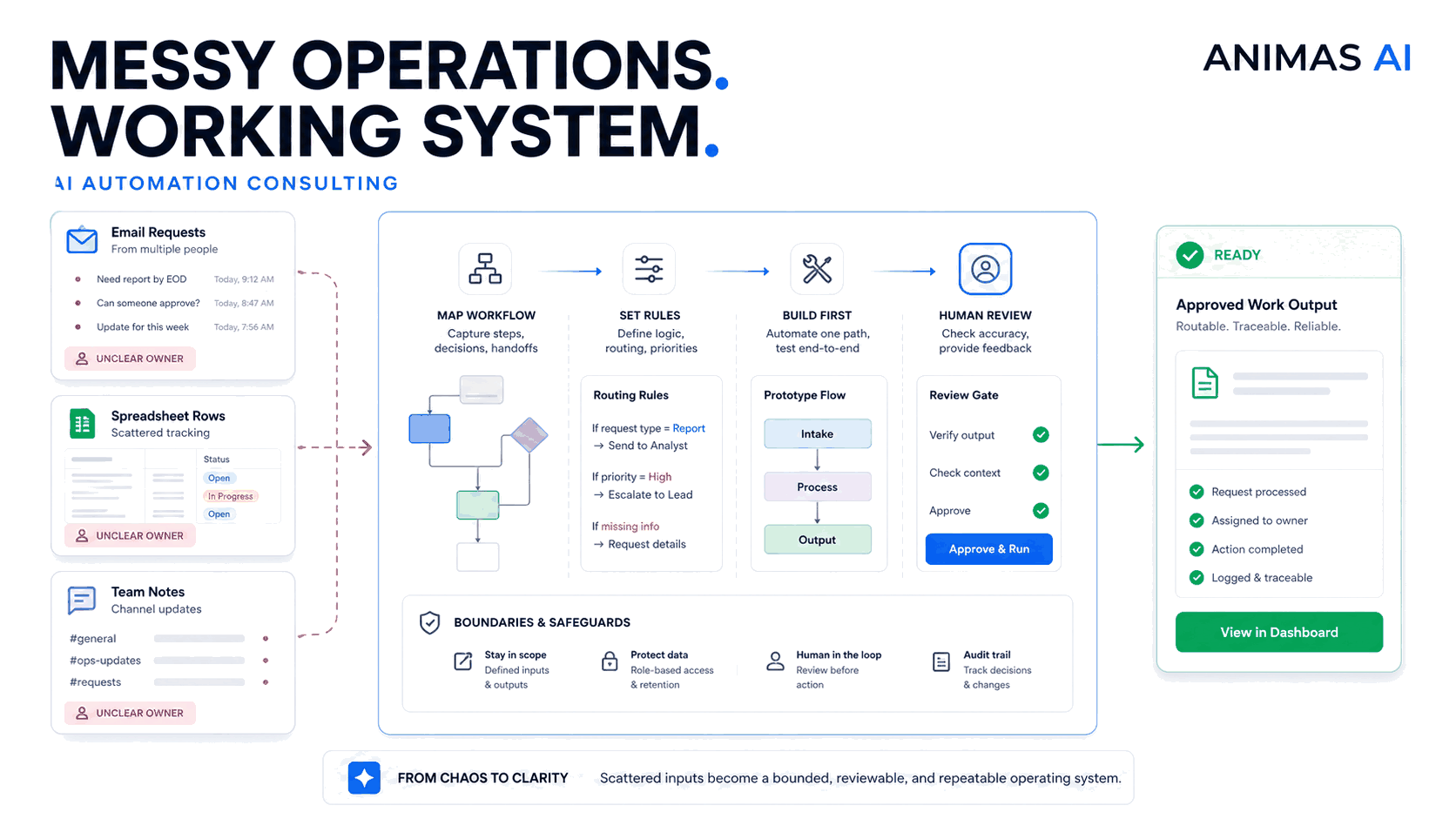
Quick answer
AI automation consulting for messy operations isn't about pristine data or perfect workflows. It's about building practical systems that work alongside the real chaos: incomplete lead info, shifting team roles, manual workarounds, and exceptions that break rigid rules. Animas AI digs into the actual process people follow, then ships small, human-in-the-loop automations that classify, extract, draft, and route work so the team moves faster without losing control. The output is not a magical black box but a maintainable internal tool that improves week by week.
A realistic workflow example
A consulting firm receives leads through a website form, a shared inbox, and forwarded referrals. Each lead must be qualified, added to the CRM, and answered within one hour. Right now, one person watches the inbox, another scans a spreadsheet, and referrals often fall through the cracks.
Trigger: A new lead lands from any source. That could be a form webhook, an incoming email, or a referral someone forwards.
Owner: A lightweight AI agent picks up the raw content and starts extracting.
Processing: The agent pulls out company name, contact info, service interest, and urgency from whatever text it gets. It works even when fields are incomplete. It checks qualification rules (budget range, location) against thresholds the team can change later.
Handoff and review state: The agent drafts a reply inside the CRM, attaches the structured data, and assigns it to the business development person on call with a status of "pending review." That person glances at the draft, can fix or add a detail, then hits send. If the AI cannot grab a must-have field like a phone number, it marks the lead as "needs enrichment" and pings a teammate to fill the gap before the draft goes out.
Output: A personalized, context-aware email goes out in minutes, logged in the CRM with a follow-up task already scheduled.
Failure path: If the reviewer is unavailable and the SLA clock is running, the system falls back to a short, templated acknowledgment. When the AI is unsure about a category, it routes the lead into a general queue with a note that explains the uncertainty. Nothing is lost silently.
This workflow replaced a manual process that once took half a day, and leads used to disappear regularly. The team now has a system that handles the repetitive grunt work, but they stay in charge of every reply.
What breaks in real teams
When teams try to automate without acknowledging the mess, a few common failures kill the project. Automations that demand perfect data break on day one because inputs show up as forwarded emails, Slack threads, and scribbled notes. Leaving out a clear human review gate destroys trust: people either double-check everything manually or approve output they don't understand. Rigid routing rules stop working the moment someone changes roles, and without a fallback queue, work gets misrouted in silence. When the AI cannot extract a field that matters, a useful system captures the gap and creates a task; systems that just throw an error lose momentum. And if the new system is slower than the old manual hack, the team will bypass it. Speed is not optional.
What to build first
Don't try to automate an entire department on day one. Pick one tight workflow where manual friction is obvious, the pain hits daily, and faster output has clear value. Lead qualification and response is a classic starting point because it's concrete, bounded, and delivers an immediate return: quicker replies mean more meetings booked. Other strong candidates include invoice scanning and approval, support ticket triage, or content approval pipelines where brand assets are scattered in different places.
The first build should follow this core loop: take in messy, unstructured input (emails, forms, documents); use AI to extract structured fields and classify; show the result to a human for a quick fix or approval; post the clean record to the destination system; log everything so the team can review and improve the model over time. Animas often ships this skeleton in a week and connects the agents to tools like Google Workspace or CRM APIs.
What to avoid
Skip the big‑bang automation that tries to map every edge case up front. That leads to analysis paralysis. Don't wait until the CRM is perfectly clean; build for the messy data you actually have and let the automation help tidy things along the way. Never skip the human‑in‑the‑loop. A person still glances and approves before a sales email or client‑facing message goes out. Build with maintenance in mind so the team can update routing rules, add fields, or adjust thresholds without a developer. And if the automation adds latency, you've built a nuisance, not a solution.
How Animas thinks about it
Animas treats messy operations consulting as practical systems design. The starting point is a walk‑through of what the team actually does, not the idealized process map. The shortcuts and workarounds show where the real pain lives. Then we ship a tight human‑in‑the‑loop automation that handles classification, extraction, and drafting while the team keeps control over every decision.
When we built Pip for consulting lead handling, the entire system went from first commit to live use in under a week. The team refined routing rules on their own in the following sprints. For content operations, Masthead followed the same approach: ingest messy brand guidelines and raw assets, then let editors approve drafted copy instead of writing from scratch. Both systems are still running and evolving because the team owns them without needing constant outside help. A typical engagement moves through a discovery sprint to pick the right workflow, a build sprint to ship the core automation, and an iteration phase where the team learns to maintain and extend the system.
FAQ
What qualifies as "messy operations"?
Operations where data arrives in inconsistent formats, processes change often, roles shift, and exceptions are the norm. Think of sales teams that handle leads from phone calls, forwarded emails, and handwritten notes, or content teams pulling assets from five different shared drives with no naming convention.
How long does a messy operations automation consulting project take?
A useful first workflow that ingests, classifies, and routes unstructured inputs can ship within a week. Broader rollouts take longer, but Animas focuses on getting one end‑to‑end loop live fast so the team sees value and learns what else to automate.
Do I need to clean my data before starting?
No. The AI is trained on the messy data you already have. The automation itself starts producing cleaner outputs, which gradually improve your records. Trying to clean everything first delays the real work.
What if my process is too chaotic to define?
That's the norm, not a blocker. We map the actual flow by watching the team work and identify the critical decision points. The automation does not need to capture every nuance, only the parts where AI can reliably speed things up without introducing risk. The rest stays manual until you're ready to automate more.
Will the system break when our team changes roles or tools?
It will if it's built as a rigid, static pipeline. Animas systems include simple admin panels for updating routing rules, adding fields, and adjusting AI thresholds. A role change becomes a quick settings update, not a rebuild.
Source notes
- Pip case study – The lead‑handling automation built to cut response times from hours to under 5 minutes.
- Masthead case study – An AI‑powered content engine designed for messy brand guidelines and fast editorial approval.
- Work page – All shipped systems from Animas AI consulting engagements.
- What I build – A breakdown of the human‑in‑the‑loop internal tools and agent workflows Animas specializes in.
- 7-Day Speed to Lead Sprint – The sprint format that ships a working lead automation inside a week.

Want this kind of system in your business?
Send the messy workflow. I will help turn it into a practical AI system.
Email Tyler