AI Automation Proof of Concept for Business: A Practical Guide
Learn how to run an AI automation proof of concept that gives you a clear go-no-go signal, with a realistic workflow example, what breaks, and how Animas AI uses PoCs in shipped systems like Pip and Masthead.
Quick answer
An AI automation proof of concept (PoC) is a small, time-boxed test that proves an automation idea works on real data and a real workflow step before you commit real resources. You pick one owner, one narrow workflow, clear acceptance gates (e.g., classification accuracy, time saved per task), and a human review step. The output is a concrete go/no-go signal, not a polished product. At Animas, we’ve used this exact pattern with Pip (email triage) and Masthead (content operations) to validate automation before scaling.
A realistic workflow example
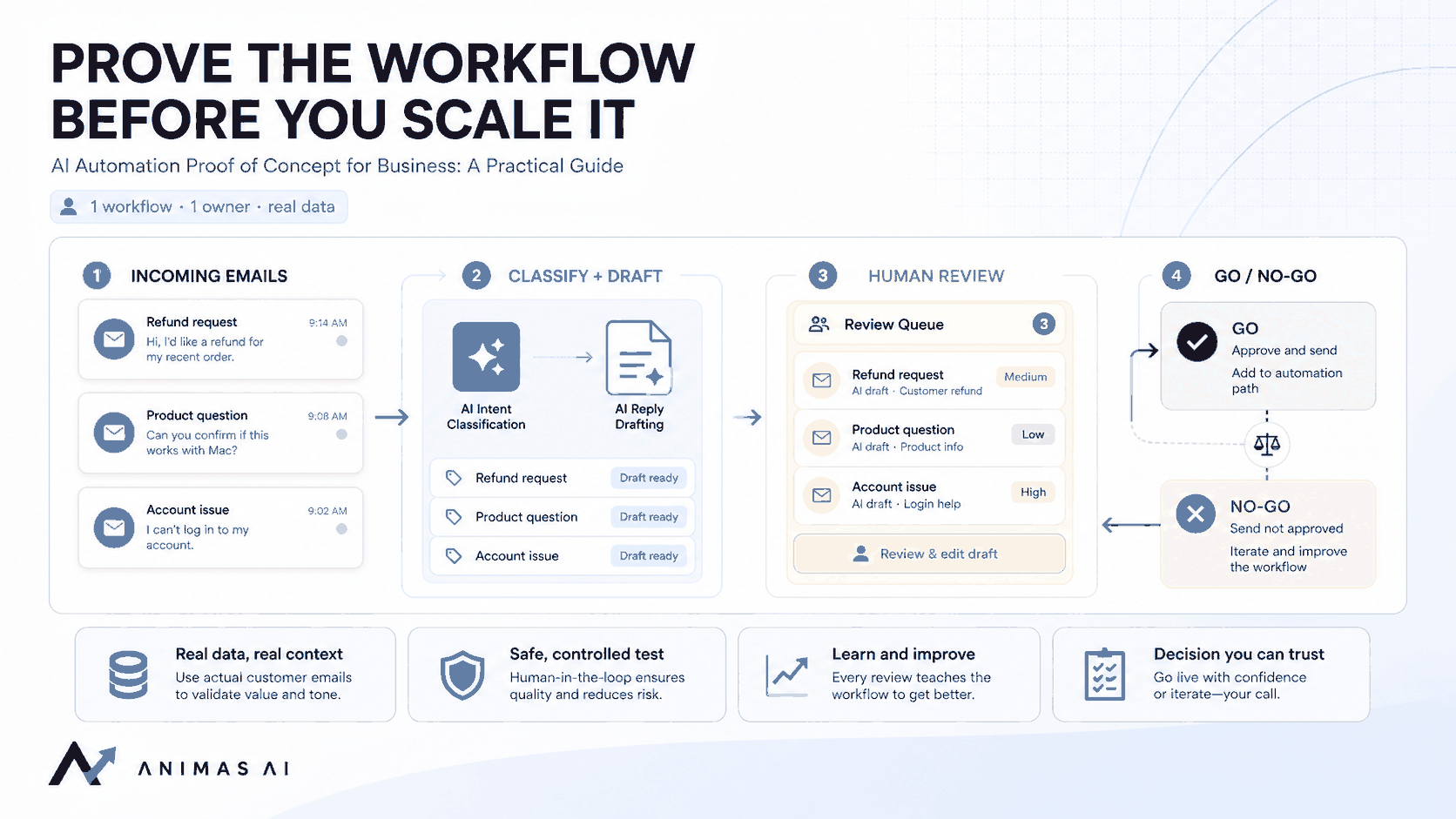
Owner: Support team lead Trigger: New customer email arrives in the shared inbox. The PoC workflow:
- A simple AI agent reads the email and classifies the intent (refund, tech issue, billing, general).
- The agent drafts a response using a fixed template for each intent.
- The draft and classification go to a human reviewer (the support lead) for approval, editing, or rejection.
- Approved drafts are sent; rejected ones are logged and the human writes the reply from scratch.
- The PoC runs for one week, processing at least 50 real emails, measuring intent classification accuracy (>90%), draft usefulness (fewer than two minor edits per email), and time saved per ticket.
Exit condition: If all three metrics hit thresholds, the PoC graduates to hardened automation with error handling and direct inbox integration. If not, the team iterates on the prompt or intent taxonomy for one more week, then makes a final go/no-go call.
This is not a theoretical exercise: the email-triage PoC pattern is the foundation Pip started from, one loop, one owner, real emails, human-in-the-loop review before any automation sent a message.
What breaks in real teams
- Scope creep from day one. Teams bolt on “what about attachments?” or “can it update the CRM?” and the PoC becomes a full build that never finishes.
- No named owner. When nobody is accountable for the go/no-go decision, the PoC drifts. One person must own the final call.
- Using synthetic data. Mock emails or sanitized spreadsheets hide real-world messiness. The first 20 production emails will break the agent in ways the PoC never saw.
- Skipping the baseline. You can’t measure “time saved” without timing the current human task first. Without a baseline, you’re guessing.
- Expecting 100% accuracy. Human-in-the-loop systems work because the AI handles the boring 80% and the human catches the edge cases. A PoC demanding perfection will be abandoned.
- No review step. Without a human checkpoint, the team gains no trust, and the output is either hidden or ignored after the test.
- Building integrations first. Wiring up APIs before proving the core logic works wastes the PoC window.
What to build first
- Define the exact workflow. One trigger, one output, one human handoff. If you need a flowchart, it’s too broad.
- Measure the current state. Time the human on 20–30 real tasks, note where they get stuck, and record the error rate.
- Set concrete acceptance gates. For example, “the agent correctly classifies intent at least 90% of the time on 50 real emails.”
- Build the simplest possible agent. Start with a single prompt and a batch CSV. Don’t build a UI or connect to live systems yet, just prove the core decision can be automated.
- Run the agent side-by-side with the human on real data. Compare results, log failures, and iterate the prompt or sample selection.
- Bring in the human reviewer on the same batch. This validates the handoff and tells you whether the AI output is actually useful in the moment, not just numerically correct.
If you’re using OpenClaw or a similar agent framework, lock the scope to one skill or one loop. In Pip, the PoC was a single “classify and draft” loop that ran on exported emails; there was no live inbox integration until the accuracy gates passed.
What to avoid
- Automating end-to-end without a human checkpoint. A PoC that sends emails or updates production data before the team trusts it will cause damage.
- Spending weeks on dashboards, notifications, or a polished UI. The PoC delivers a decision, not a product.
- Leaving acceptance criteria fuzzy. “Make the team faster” isn’t testable. Pick a number.
- Running the PoC on the IT manager’s machine instead of the actual operator’s. The person who will use the automation must be the reviewer; otherwise the feedback is useless.
- Treating the PoC as a one-way street. If the metrics don’t hit the threshold, kill it or narrow the scope further. Letting a failing PoC slide into production is how automation projects disappoint everyone.
How Animas thinks about it
Animas AI builds PoCs that are designed to become production artifacts if they pass the gates. We use the same infrastructure, OpenClaw agents, prompt patterns, and human-in-the-loop routing, from day one. The only difference is scope: a PoC locks the system to one loop, a small batch of real data, and a hard stop after 1–2 weeks.
In Pip, the PoC proved that an agent could classify and draft responses for noisy hospitality emails well enough that a human reviewer needed only a few seconds per message. That single-loop signal justified the full build. In Masthead, the PoC tested whether an agent could structure raw editing briefs into consistent content templates; once the structure held, we expanded to multi-step content operations.
Animas AI treats a PoC as a decision-making tool, not a science project. The goal is to answer one question: *“Is this automation worth building for real?”* If the answer is yes, the PoC’s code and configuration become the starting point for the production system. If no, you’ve spent two weeks and learned something concrete, instead of six months and a burnt team.
See the shipped systems where PoCs turned into operational automation.
FAQ
How narrow should a business AI PoC be?
One workflow, one owner, one trigger, one handoff. “Classify incoming support emails and draft a reply for human review” is a good scope; “automate customer support” is not.
How long should a PoC last?
1–2 weeks. Three weeks if data trickles in slowly. Set a hard stop date when you begin.
What data size do I need to prove anything?
50–100 real records usually surfaces the most common failure modes. Fewer than 30 items won’t give confidence; more than 200 starts to feel like a mini-production run. Start with a manageable chunk.
What if accuracy is below the threshold?
Iterate the prompt, examples, or classification taxonomy for a maximum of two or three cycles. If the numbers don’t trend upward, halt the PoC. An honest “no” is more valuable than a forced “yes” that collapses later.
Can a PoC include real integrations?
Only if the integration is necessary to test the core logic. Otherwise, mock the integration with a CSV import or a manual copy-paste step. You’re testing the decision, not the plumbing.
Source notes
This article draws on the internal practice Animas has used to ship Pip, Masthead, and other operational AI systems. No client-specific data, private metrics, or invented case studies are included. Every workflow pattern described here has been executed in real shipped automations.

Want this kind of system in your business?
Send the messy workflow. I will help turn it into a practical AI system.
Email Tyler