AI Internal Tools for Founder-Led Teams
A practical guide to building AI-powered internal tools for founder-led teams, with concrete workflows, common failure points, and how Animas AI ships systems that actually get used.
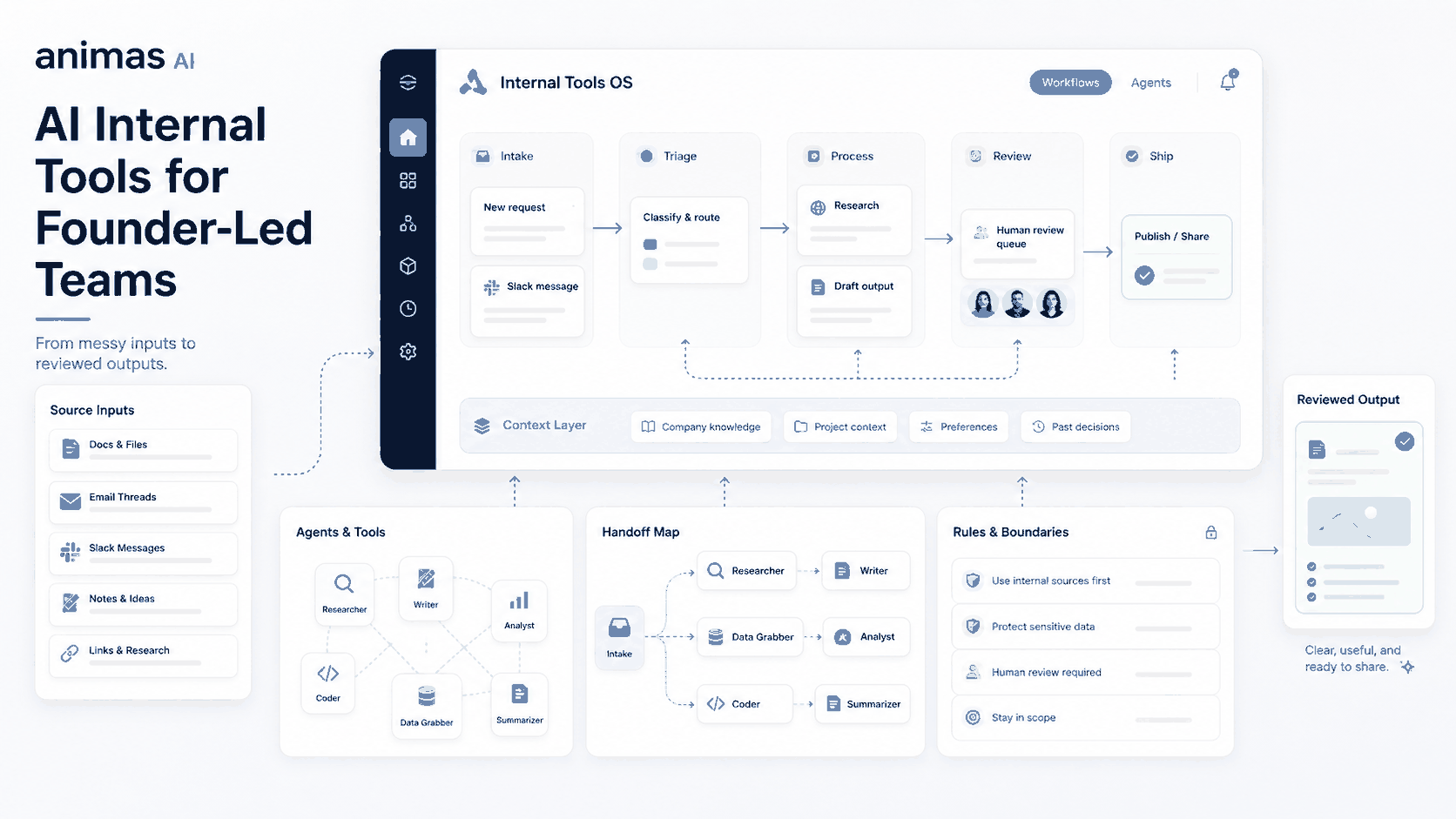
Quick answer
AI internal tools for founder-led teams are small utilities that use language models or automation to handle repetitive tasks like lead qualification, data extraction, meeting prep, and cross-checking spreadsheets. They sit behind dashboards or chat interfaces, owned by one person, and replace manual work with structured workflows that produce a decision rather than more information. When the founder who understands the problem works closely with a developer who can ship quickly, these tools cut context-switching and let the team handle more volume without new hires.
A realistic workflow example
Consider a founder-led services firm that receives dozens of inbound leads through a contact form. The owner manually reviews each one, qualifies it against a CRM, then drafts a personalized response in under 5 minutes. In a team of three, that process often breaks because the owner is in back-to-back client meetings.
An AI internal tool can automate the triage:
- Trigger: A new form submission hits a webhook (Zapier, Make, or a lightweight queue).
- Owner: The founder or ops lead defines the qualification rules: must match service offering, budget threshold, and geography.
- Step 1: The tool extracts the lead’s message, runs it through a classifier (e.g., a fine-tuned GPT-4o-mini prompt) that returns “good fit,” “needs more info,” or “not a fit.”
- Step 2: If “good fit,” the tool pulls relevant project history from the team’s Notion knowledge base and drafts a reply in the founder’s voice, inserting the right case-study links.
- Review state: The draft sits in a “pending review” queue inside a shared Slack channel or a simple internal dashboard. The founder or a senior team member can approve, edit, or reject with one click. Approval sends the email via Gmail API.
- Output: A personalized, on-brand response within 2 minutes of lead submission, with human oversight.
- Failure path: If the classifier confidence is below 80%, the lead is flagged for manual review with a note, and no email is sent automatically. The system logs the low-confidence case so the founder can adjust the prompt.
This is not a fully autonomous agent; it’s a structured internal tool that handles the predictable 80% of triage while keeping the final call with a person.
What breaks in real teams
Founders often underestimate the maintenance cost of a tool that “works on my machine.” When the single engineer who built it leaves or gets busy, small changes, like an updated form field or a tweak in the qualification criteria, fall into a backlog. Without clear ownership beyond the initial build, the tool degrades.
Another failure mode is over-automation. Founders who chase the ideal of a fully autonomous system remove the review step too early, and the AI-generated responses drift off-brand or sound generic. The team loses trust, and the tool gets abandoned.
Finally, tight coupling to brittle integrations causes breakage. A tool that relies on a spreadsheet with a specific column order fails when someone renames a tab. Internal tools for small teams must tolerate the messy reality of operations: free text, inconsistent data, and people bypassing the process.
What to build first
Start with a workflow that has high volume, low judgment variability, and a clear owner. Good candidates:
- Lead qualification and first response drafting (as above).
- Meeting prep briefs: Pulling recent email threads, CRM notes, and project status into a one-page summary before a client call.
- Invoice data extraction: Taking PDF invoices from contractors and populating a tracking spreadsheet, with flagged discrepancies.
The first tool should output something a person reviews and then acts on, not a final decision. That way, the founder stays in the loop, learns the tool’s edge cases, and builds confidence. That’s the kind of tool I deliver for clients (see the solutions page), always starting with a reviewable artifact.
What to avoid
- Bypassing the review step: Even if the AI is 95% accurate, the 5% error rate erodes trust. Always keep a human in the loop for at least the first few weeks.
- Starting with a chatbot: Founders love the idea of an “AI assistant,” but open-ended chat interfaces create ambiguity. Instead, build a tool with a single clear job and a button that does that job.
- Over-engineering the stack: A simple Cloud Function calling an LLM and posting to Slack is more reliable than a full microservices setup for a team of five. Avoid Kubernetes and vector databases until you have a concrete need.
- Ignoring the failure notification: Every tool needs a “something broke” path that alerts the team with a Slack message, email, or PagerDuty if critical. Without it, silent failures accumulate.
How Animas thinks about it
We treat internal AI tools as operational utilities, not research projects. The goal is to reduce the time between a trigger event and a human decision. That event could be a lead form submission, a new support ticket, or a spreadsheet update. The tool’s value is measured in minutes saved per instance, multiplied by frequency, and judged against the overhead of maintenance.
Our process mirrors what you’d see in our shipped systems: for example, the Pip case study shows an internal tool that helps a team manage project knowledge, and Masthead demonstrates a tool for content operations. Both started small, with a single owner, clear triggers, and a review state. The architecture is deliberately boring: webhooks, lightweight serverless functions, and an LLM call that returns structured JSON, so the team can modify it without a specialist.
We push founders to define the “done” state of a tool: it must log every action, have a rollback or undo path, and include a dashboard that shows recent runs. This makes it auditable and keeps the human decision-maker accountable. See more of our work for real patterns.
FAQ
Why should a founder-led team build internal AI tools instead of buying SaaS?
Off-the-shelf SaaS often forces you to adapt your workflow to its structure. An internal tool can mirror exactly how your team already works, like your naming conventions, review steps, and approval chains. It also avoids per-seat pricing that hurts small teams. The trade-off is you own the maintenance, but for high-value, repetitive processes the ROI is clear.
How much does it cost to run a typical internal AI tool?
Running costs are usually trivial: a few dollars a month in cloud functions and LLM API calls for thousands of actions. The real cost is the initial build time and ongoing maintenance. A focused tool can be built in a week by a capable developer, and maintenance might require a couple hours per month to adjust prompts or integrations.
Can a non-technical founder spec out an AI internal tool?
Yes. The best specs come from the person feeling the pain. You don’t need to know code; you need to describe the trigger, the data you have, what a good output looks like, and how you’d review it. The builder (whether internal or external) translates that into a prompt, a data model, and a delivery mechanism. At Animas, we start every engagement with a workflow mapping session that captures exactly this.
What is the difference between an internal AI tool and an AI agent?
An agent makes decisions autonomously and can take actions without a person in the loop. An internal tool surfaces information or drafts output but leaves the final action to a human. For founder-led teams, starting with a tool is safer and builds the muscle memory for future automation. You can graduate to agents later, but only after you’ve seen the failure modes.
Source notes
- Based on internal Animas AI build patterns for clients like Pip and Masthead.
- The lead qualification workflow draws from real systems we’ve shipped for services firms (no client names).
- Review and ownership principles come from direct experience with internal tools that degraded when the builder left.
- The advice to avoid chatbots first is informed by failed experiments where open-ended interfaces caused confusion rather than efficiency.

Want this kind of system in your business?
Send the messy workflow. I will help turn it into a practical AI system.
Email Tyler